Free tool

YouTube Video Money Calculator.

See how much a YouTube channel can earn from its views. Pick long videos or Shorts, enter daily views, choose a niche and audience, and get a daily, monthly and yearly estimate. Works as a YouTube income, ad revenue and monetization calculator in one.

How much does YouTube pay per view? About $0.001 to $0.01 per view on long videos, which is $1 to $10 per 1,000 views and $1,000 to $10,000 per 1 million views. Shorts pay roughly $0.03 to $0.08 per 1,000 views. Use the calculator below for your own channel.
views / day
1001K10K100K1M
Estimated earnings
$1,200 to $3,000per month
Per day$40 to $100
Per year$14,600 to $36,500
RPM used$4.00 to $10.00

Estimate only. Earnings start after a channel joins the YouTube Partner Program.

Skip the 1,000 subscribers and 4,000 hours wait.See monetized channels โ†’

How much does YouTube pay per view?

Typical earnings for long videos at $1 to $10 per 1,000 views. Finance, business and tech channels with US viewers sit at the top of the range or above it.

ViewsLong videosShorts
1 view$0.001 to $0.01$0.00003 to $0.00008
1,000 views$1 to $10$0.03 to $0.08
10,000 views$10 to $100$0.30 to $0.80
100,000 views$100 to $1,000$3 to $8
1 million views$1,000 to $10,000$30 to $80

Pay changes a lot by country. See how much YouTube pays in 30 countries, or check if your channel can earn yet with the monetization checker.

Real revenue from channels we monetized

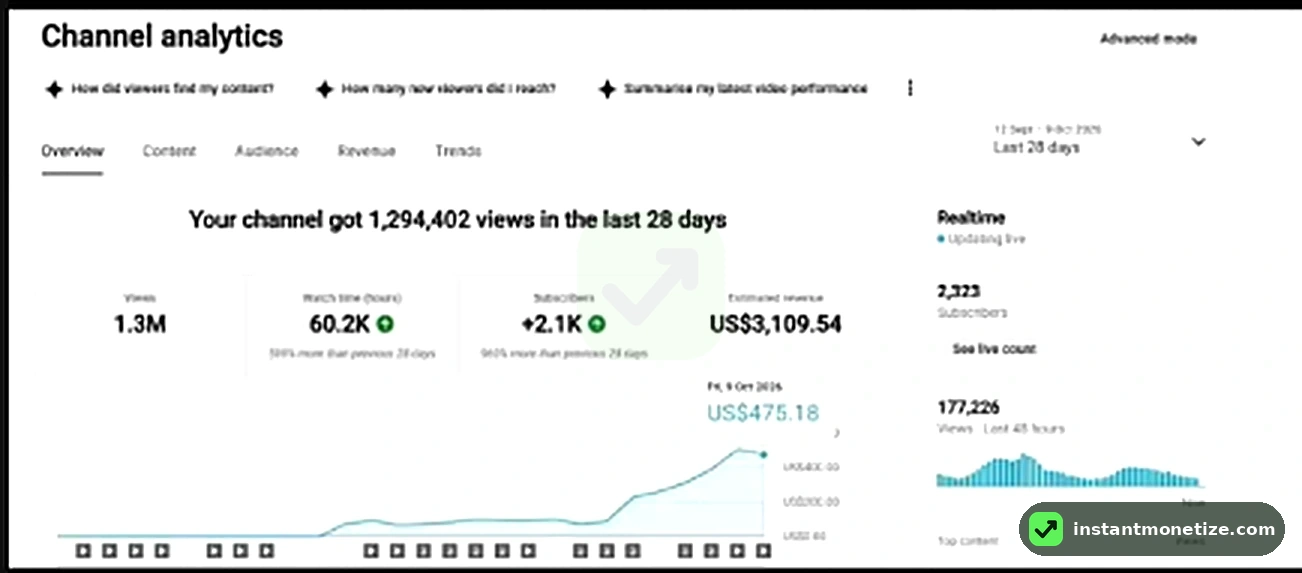
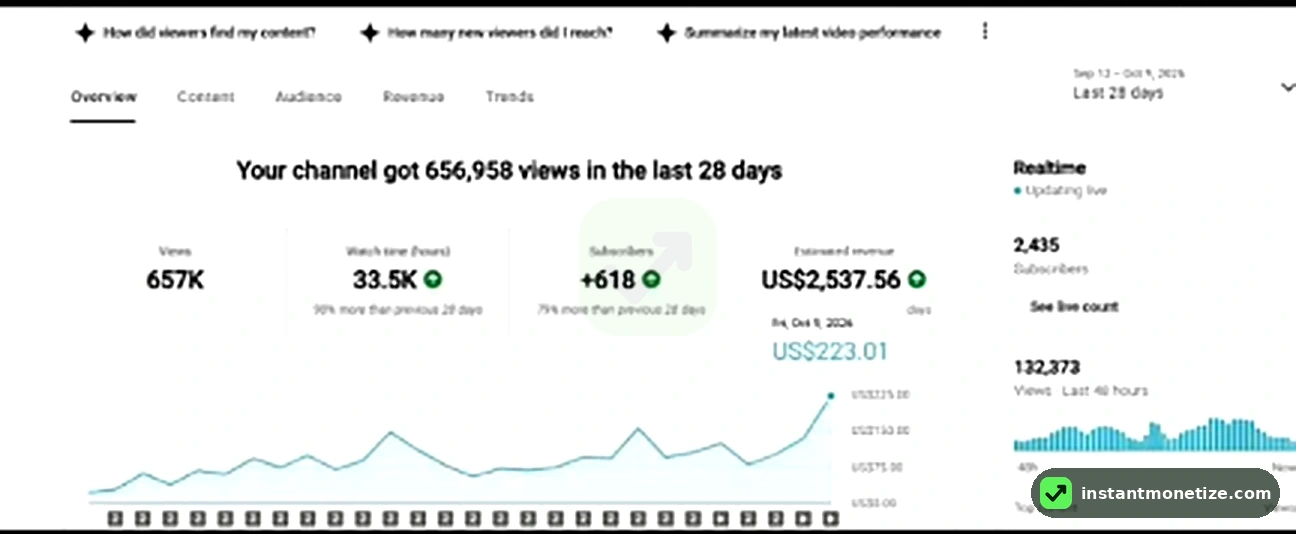
Not estimates: YouTube Studio screenshots from channels we grew and monetized, showing what they earned in 28 days.

YouTube Studio: US$3,109 estimated revenue from 1.3M views in 28 days
US$3,109 from 1.3M views in 28 days
YouTube Studio: US$2,537 estimated revenue from 657K views in 28 days
US$2,537 from 657K views in 28 days

That works out to roughly $2.40 to $3.90 per 1,000 views, right inside the range this calculator uses. Start with a monetized channel โ†’

YouTube RPM by niche

Typical RPM (what a creator keeps per 1,000 views) for long videos with a mostly US or UK audience. Shorts usually earn $0.03 to $0.08 per 1,000 views in any niche.

NicheRPM per 1,000 views
Finance and investing$8 to $20
Business and marketing$6 to $15
Tech and software$4 to $10
Education and how-to$3 to $8
Health and fitness$3 to $7
Travel and food$2 to $6
Gaming$1.5 to $4
Entertainment and vlogs$1 to $4
Music$0.5 to $2.5
Kids and animation$0.5 to $2

How the estimate works

The calculator multiplies your views by a typical RPM range for your niche, then adjusts it for where your viewers live:Earnings = (views รท 1,000) ร— RPM ร— audience factorMonthly figures use 30 days and yearly figures use 365 days. Real income moves with the season (ad rates are higher before the holidays), video length, watch time and the share of viewers who see ads. Ad revenue only starts after a channel meets the YouTube Partner Program requirements.

How much do YouTubers make in 2026?

There is no single answer, because YouTube does not pay a fixed amount per view. A channel earns a share of the money advertisers spend to show ads on its videos. For long videos, YouTube keeps 45% of that ad revenue and the creator keeps 55%. That creator share, measured per 1,000 views, is called RPM.

Most monetized channels see an RPM between $1 and $10 on long videos. A gaming channel with a young, worldwide audience might sit near $2, while a personal finance channel with US viewers can pass $15. That is why two channels with the same views can earn very different amounts.

How many views do you need to make $1,000?

At an RPM of $1, you need about 1 million views. At $5, about 200,000 views. At $10, about 100,000 views.

  • $1,000 a month at a $4 RPM needs roughly 250,000 views a month, or about 8,300 a day.
  • $100 a day at a $4 RPM needs roughly 25,000 views a day.
  • On Shorts, $1,000 usually takes about 12 to 33 million views.

What changes how much a channel earns

  • Niche. Advertisers pay more to reach people who are about to spend money, such as on finance, software or business tools.
  • Viewer location. Views from the US, UK, Canada and Australia earn several times more than views from most other countries.
  • Video length. Videos of 8 minutes or longer can show mid-roll ads, which can raise earnings per view.
  • Time of year. Ad prices usually rise from October to December and drop in January.
  • Watch time. Viewers who watch longer see more ads, so strong retention lifts RPM.

Long videos vs Shorts

Shorts revenue comes from a shared pool, and creators keep 45% of their share. In practice Shorts earn far less per view, often 3 to 8 cents per 1,000 views. Many creators use Shorts to grow subscribers quickly and long videos to earn.

Other ways YouTubers earn

Ads are only one part of the picture. Established channels also earn from sponsorships, affiliate links, channel memberships, Super Thanks and selling their own products. For many mid-size channels, sponsorships pay more than ads.

How to raise your YouTube earnings

  • Pick topics that advertisers value, or cover them inside your current niche.
  • Make some videos 8 minutes or longer, and only when the topic supports it.
  • Improve the first 30 seconds of each video to keep more viewers watching.
  • Add an affiliate link or sponsor once the channel has steady views.

None of this starts until the channel is in the YouTube Partner Program. If you would rather not spend months reaching 1,000 subscribers and 4,000 watch hours, you can start with a monetized YouTube channel or an aged channel.

Two ways to start earning

Add this YouTube money calculator to your site

Run a blog, a creator community or a course? Paste this code into any page to show a free YouTube earnings estimator to your readers. It is free to use, as long as the credit link stays in place.

Frequently asked questions

How much does YouTube pay per view?

About $0.001 to $0.01 per view for long videos, which is $1 to $10 per 1,000 views. Shorts pay far less, roughly $0.00003 to $0.00008 per view. The exact amount depends on the niche, the viewers' country and the time of year.

How much does YouTube pay per 1,000 views?

For long videos, most channels keep between $1 and $10 per 1,000 views (this is called RPM). Finance, business and tech channels with US or UK viewers can earn more. Shorts usually pay a few cents per 1,000 views.

How much does YouTube pay for 1 million views?

For long videos, 1 million views often earns somewhere between $1,000 and $10,000, depending on the niche and where viewers live. For Shorts, 1 million views is closer to $30 to $80.

What is the difference between CPM and RPM?

CPM is what advertisers pay per 1,000 ad views. RPM is what you actually keep per 1,000 video views, after YouTube's share and after counting views that showed no ad. RPM is the number that matters for your income, so this calculator uses RPM.

Do I need to be monetized to earn from views?

Yes. Ad revenue only starts once a channel is accepted into the YouTube Partner Program. Full monetization needs 1,000 subscribers plus 4,000 public watch hours in the last 12 months, or 10 million public Shorts views in the last 90 days.

Why does audience location change earnings so much?

Advertisers pay more to reach viewers in countries with higher spending, such as the US, UK, Canada and Australia. The same video can earn several times more from those viewers than from viewers elsewhere.

Is this calculator accurate?

It gives an estimate based on typical RPM ranges, not a promise. Real earnings depend on watch time, season, ad types, video length and many other factors. Use it to plan, then check real numbers in YouTube Studio.

Keep reading

More free tools for creators

YouTube Monetization Checker โ†’How close you are to the Partner ProgramTikTok Money Calculator โ†’Creator Rewards earnings by countryTikTok Monetization Checker โ†’Do you qualify for Creator Rewards?YouTube Banner Size Checker โ†’See how your banner crops on every deviceUsername Generator โ†’Channel names and handles in secondsFancy Text Generator โ†’Cool fonts for your name and bio
See all free tools โ†’