Is It Legal to Buy a YouTube Channel? Law vs YouTube Rules (2026)
People buy YouTube channels every day, on marketplaces and from direct sellers. But many first-time buyers still ask the same question before they pay: is this actually legal? The honest answer has two parts. There is the law, and there are YouTube's own rules. They are not the same thing, and you need to understand both before you buy.
What the law says
In most countries there is no law that bans buying or selling a YouTube channel. A channel is a digital asset, a bit like a domain name or a website. Two people can agree on a price and move it from one to the other. Laws on fraud, tax and consumer protection still apply to the deal itself. If a seller lies about the channel or takes your money and disappears, that is fraud, and it is the seller who breaks the law.
What a buyer cannot do is use a bought channel for something illegal, such as pretending to be the original creator to mislead viewers, or running scams. Rules differ from country to country. If you are buying a channel for a business or for a large amount of money, talk to a local lawyer or accountant.
What YouTube's rules say
This is where most of the confusion comes from. YouTube's Terms of Service do not include a section on selling a channel. They do not describe it as allowed, and they do not offer a way to do it. What they do say is that you should keep your Google account password confidential. So handing a buyer your own Gmail login is not the way YouTube expects accounts to be used.
What YouTube does support is shared ownership through a Brand Account. A channel on a Brand Account can have several owners and managers. According to the YouTube Help Center page Change channel owners and managers with a Brand Account (support.google.com/youtube/answer/4628007), an owner can make themselves the primary owner, but only after being an owner for 7 days or more. Every Brand Account has one primary owner. This is the mechanism that serious sellers use, because the buyer gets real ownership on their own Google account and no passwords change hands.
YouTube's terms also ban anything that causes inaccurate measurements of genuine user engagement. That means channels grown with bought views, subscribers or watch hours are a risk, whoever owns them. The policy follows the channel, not the person.
Legal vs allowed by YouTube: side by side
| Question | Under the law (most countries) | Under YouTube's rules |
|---|---|---|
| Is buying a channel banned? | Generally no, it is a private sale | Not supported, but there is no section about sales |
| Supported way to move a channel | Any written agreement between buyer and seller | Brand Account ownership transfer (owner for 7 days, then primary owner) |
| Sharing a Gmail password | Not a legal issue in itself | YouTube asks you to keep your password confidential |
| Fake views or subscribers | Can be fraud if used to mislead the buyer | Breaks YouTube's fake engagement rules |
| Who is responsible after the sale | Depends on the contract and the seller | The new owner, for everything uploaded |
General information based on YouTube's Terms of Service and Help Center in October 2026. Not legal advice.
Do you need a contract when you buy a channel?
The law does not usually require a special contract for a private sale, but a short written agreement protects both sides. On a marketplace, the escrow record and messages often play that role. In a private deal, write it down yourself. A useful agreement covers:
- What is being sold: the channel URL, and anything extra such as logo files or social pages.
- The price, the payment method and when the money is released.
- How ownership moves: you are added as an owner on your own Google account and become primary owner after YouTube's 7-day wait.
- What the seller confirms about the channel: monetization status, no strikes, no bought engagement.
- What happens if the channel cannot be transferred or is not as described.
Keep the agreement, every message and the payment receipt. If something goes wrong, that record is what a payment provider, marketplace or court will look at.
Do you pay tax on a bought channel's earnings?
Usually, yes. Once the channel is yours, the ad revenue paid to your AdSense account is your income, and most countries tax it like other self-employed or business income. Google AdSense will also ask you for tax information. The price you paid for the channel may count as a business cost in some countries. Rules vary widely, so ask a local accountant before you file.
Country and account rules for monetization
Owning a monetized channel is not quite enough to get paid. According to YouTube Help, to be in the YouTube Partner Program you must live in a country or region where the program is available, have 2-Step Verification turned on for your Google Account, and link one active AdSense for YouTube account to the channel. Check that all three apply to you before you buy.
The real risks when you buy a YouTube channel
Whether a deal is legal is only part of the question. The bigger question is whether you keep what you paid for. These are the risks that actually cost buyers money.
- Scams. A fake seller shows screenshots of a channel they do not own, takes payment and disappears. Always see a live screen recording of YouTube Studio.
- Recovery by the seller. If the seller keeps owner access, or sold you a personal Gmail they can recover, they can take the channel back. Only Brand Account primary ownership on your own Google account is safe.
- Policy strikes. Community Guidelines or copyright strikes stay with the channel. Three Community Guidelines strikes in 90 days can end a channel.
- Reused content. A channel that grew on re-uploaded clips or compilations can lose monetization at its next review, even if it is monetized today.
- AdSense. Earnings go to the AdSense account linked to the channel. Make sure your own AdSense for YouTube account is linked after the transfer, not the seller's.
- Fake engagement. Bought views or subscribers break YouTube's rules and can lead to removal of views, demonetization or termination.
How to buy a YouTube channel safely, in short
- See live proof in YouTube Studio: the Earn page, analytics, traffic sources and strike status.
- Insist on a Brand Account transfer to your own Google account, never a Gmail login and password.
- Pay through escrow or a seller with a written guarantee, and keep every record.
The 2027 Partner Program change and why it matters for buyers
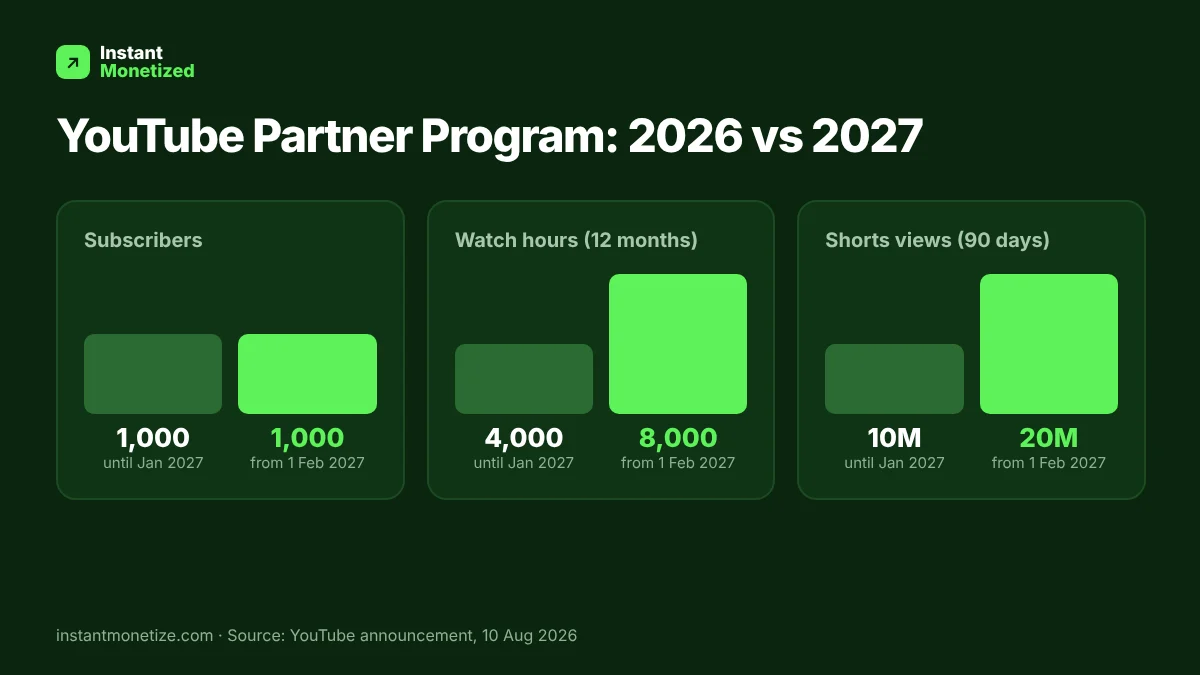
From 1 February 2027, new applicants need 1,000 subscribers plus 8,000 qualified watch hours in the last 365 days, or 20 million qualified Shorts views in the last 90 days. Channels already in the YouTube Partner Program are not affected by the new entry thresholds, which is one reason buyers look at monetized channels. Existing partners do need to accept YouTube's updated terms in Studio, so check for pending agreements as soon as you are an owner.
How we do it (this is us)
We only use YouTube's supported Brand Account transfer. Within 12–24 hours your own Gmail is added as an owner of the channel. YouTube lets a new owner become primary owner after 7 days, and we help you take primary ownership and remove every other owner. Every monetized channel is already in the YouTube Partner Program and comes with a 30-day replacement or refund, plus 30 days of support.
After any transfer, lock the channel down before you upload.
Is it illegal to buy a YouTube channel?
In most countries, no. It is a private sale of a digital asset. Fraud, tax and consumer laws still apply to the deal. This is general information, not legal advice.
Does YouTube allow selling channels?
YouTube does not officially support account sales and its terms have no section about them. It does support Brand Account ownership transfer, where an owner can become primary owner after 7 days.
Can YouTube ban a channel because it was sold?
YouTube enforces its rules on the channel's content and activity. Strikes, reused content and fake engagement are the usual reasons channels lose monetization or are removed, whoever owns them.
Do I need a contract to buy a YouTube channel?
Not usually by law, but a short written agreement is wise. It should name the channel, the price, how ownership moves and what happens if the channel is not as described.
Do I have to pay tax on a bought channel's earnings?
Usually yes. Ad revenue paid to your AdSense account is income in most countries, and AdSense asks for your tax information. Ask a local accountant how it applies to you.
Do bought channels need to meet the 2027 requirements?
No. The 8,000 watch hour rule is for new applicants from 1 February 2027. Channels already in the program are not affected by the new entry thresholds, but must accept YouTube's updated terms.